An Interview with Christine M. Levy, M.Ed., on Educational Advocacy and Family Well-Being

Maybe you’ve been rereading an email from your child’s teacher, wondering how to respond. Maybe school mornings have become difficult, or you’re heading into another meeting with questions you’re not sure how to ask. Even when you know your child needs support, figuring out what that support should look like can feel overwhelming.
And somewhere between the appointments, conversations, and decisions, you may find yourself wondering: Are we doing enough? Are we missing something? How do we keep doing this?
At Hudson Valley Holistic Therapy, we make room for the emotional experience that comes with caring for someone you love. When your child is struggling, you may be carrying worry, exhaustion, tension in your relationship, or grief about how different things feel from what you had imagined. Those feelings deserve attention, too.
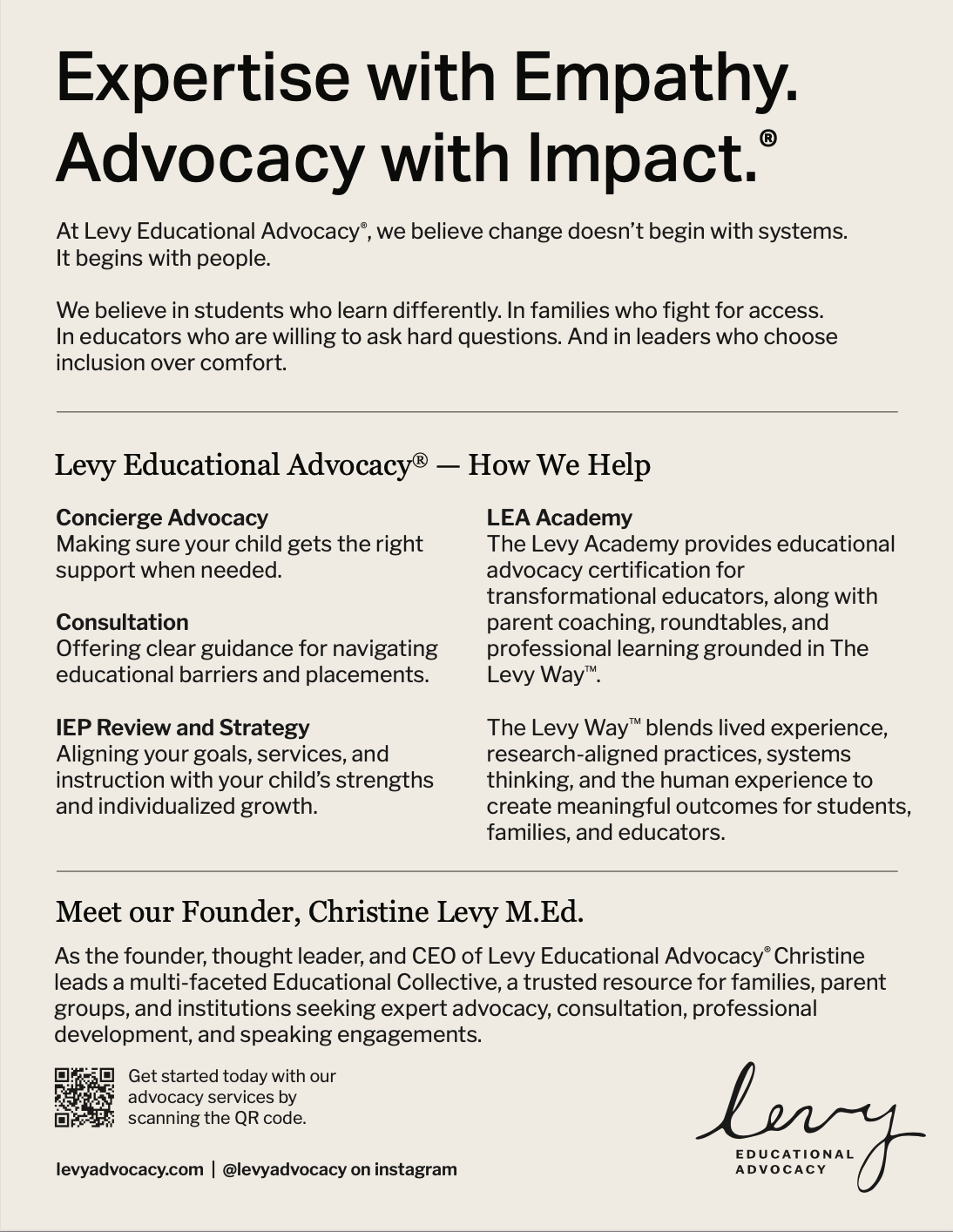
I wanted to explore this with Christine M. Levy, M.Ed., Founder and CEO of Levy Educational Advocacy® and creator of The Levy Way™. Christine is an educational advocate, speaker, and PANS/PANDAS-informed professional whose guiding philosophy is Expertise with Empathy. Advocacy with Impact.®
Our conversation looks at what happens beyond the school meeting: how parents can feel supported, how stress can show up differently within a family, and what it means to take the next step when you don’t yet have all the answers.
Steph: When a child is struggling, what do parents often overlook about their own well-being?
Christine: Parents often become so focused on helping their child that they stop seeing themselves.
They become researchers, coordinators, advocates, appointment schedulers, and problem-solvers. They're reviewing evaluations, navigating IEPs and 504 Plans, communicating with teachers, and determining what their child needs next.
Meanwhile, their own emotional well-being becomes an afterthought.
Parents may experience guilt, worry, grief, frustration, or exhaustion. They may wonder, Am I doing enough? Should I have known sooner?
One foundational principle of The Levy Way™ is to SEE. We have to see the whole child, but also the whole family.
Taking care of yourself isn't taking time away from your child. It helps you show up with greater clarity, patience, and capacity.
How can educational advocacy affect couples and the broader family?
Christine: Parents may respond to uncertainty differently. One may pursue every evaluation immediately, while another needs time to process. One becomes intensely focused on advocacy, while the other pulls back because it feels overwhelming.
That doesn't mean one parent cares more. They're often responding differently to stress.
Instead of asking, Who's handling this the right way? couples can ask, What is each of us experiencing, and what do we need?
Siblings matter, too. They may feel worried, confused, or overlooked, even when parents are doing their best.
The goal isn't simply to solve an educational problem. It's to create greater connection, stability, and understanding throughout the family.
How can parents create stability when they're feeling uncertain themselves?
Christine: Parents don't have to pretend everything is okay.
I encourage honest reassurance:
“We're figuring this out.”
“We don't have all the answers yet, but we're going to keep asking questions.”
“You don't have to figure this out alone.”
These statements communicate safety and support without promising certainty.
There's also an important connection to co-regulation. A parent's emotional state can influence the environment around a child, but parents don't need to be perfectly calm.
Sometimes it's enough to recognize, I'm overwhelmed, and I need to pause.
Children benefit from seeing adults acknowledge difficult emotions and model ways of moving through them.
What helps parents navigate difficult school meetings and evaluations?
Christine: First, you don't have to know everything.
You can ask questions, request clarification, take time to think, and bring support.
Before a meeting, identify three priorities: What do I know? What do I still need to understand? What does my child need next?
I also encourage parents to separate facts from assumptions.
For example, “My child refuses school” tells us less than “My child has been unable to enter the school building three mornings this week.”
Specific observations help us build an accurate educational picture using documentation, data, student voice, family input, and professional expertise.
Advocacy doesn't have to begin with a crisis. Sometimes the most effective advocacy starts when someone notices something isn't working and becomes curious about why.
Why is collaboration between therapists, educational advocates, schools, and families so valuable?
Christine: Because no one person sees the whole child.
Therapists understand emotional experiences and relationships. Educational advocates understand evaluations, accommodations, services, and educational access. Teachers observe students in the classroom. Parents bring deep knowledge of their children.
When those perspectives remain separate, important pieces can be missed.
A child avoiding school may be experiencing an academic, social, emotional, sensory, or environmental challenge. Instead of jumping to conclusions, we need to ask: What is this child communicating? What does the data tell us? What does the family know?
That's where therapeutic support and educational advocacy intersect so meaningfully.
What would you want parents navigating a difficult educational journey to remember?
Christine: You don't have to figure everything out at once.
Sometimes the most important thing is identifying the next right step. Ask the question. Gather information. Talk with your child. Seek support. Then reassess.
Your child doesn't need you to have every answer. They need you to remain curious, listen, believe them, and keep showing up.
That's the heart of The Levy Way™:
SEE. LISTEN. DOCUMENT. CONNECT. RESPOND. REASSESS.
When we understand the whole picture and bring the right people together, we can move from uncertainty toward meaningful support.
There’s Room for Your Experience, Too
What I keep coming back to in this conversation is how easily a parent’s own experience can disappear behind everything that needs to get done. You might be able to explain every detail of your child’s school day and still struggle to answer when someone asks, How are you doing with all of this?
You can be a thoughtful, committed parent and feel exhausted. You can love your child deeply and wish things felt easier. You can be grateful for the support available and still feel overwhelmed by the work of finding and coordinating it.
If this conversation feels familiar, consider starting with one question: What support would help me feel a little less alone in this? That might mean asking someone to come to a school meeting, making space for an honest conversation with your partner, or having somewhere to talk about your own feelings without needing to move immediately into problem-solving.
Levy Educational Advocacy® helps families understand their child’s educational needs and navigate school supports. At Hudson Valley Holistic Therapy, we offer space to work through the stress, relationship challenges, and emotions that can come alongside that process.
You don’t have to wait until everything is figured out for your own experience to have a place.